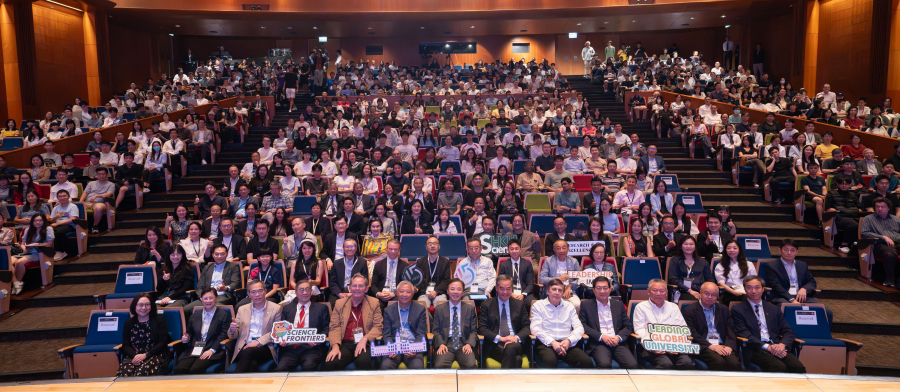
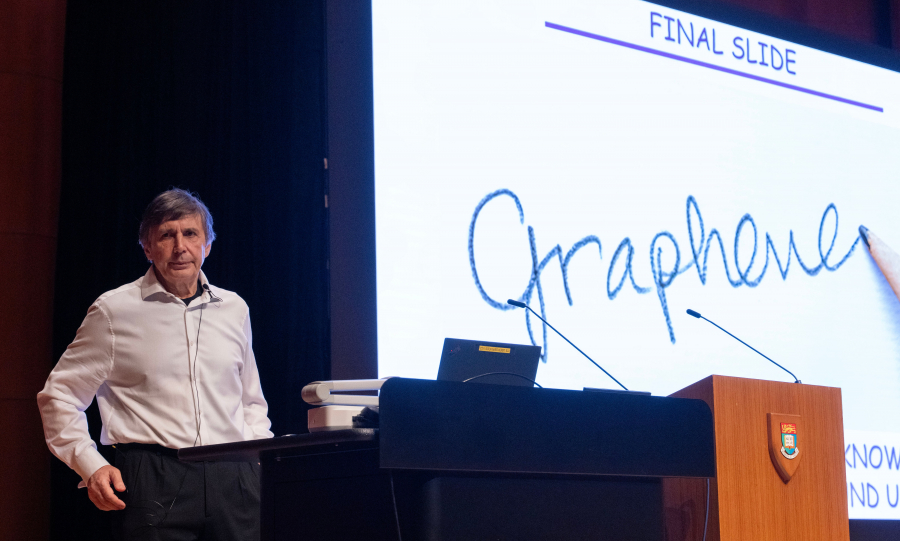
Professor Sir Andre Geim, Nobel Laureate and Chair Professor in the Department of Physics under the Faculty of Science at the University of Hong Kong (HKU), delivered his inaugural lecture titled "Random Walk to Graphene" on 9 June. Held at the Grand Hall of the Lee Shau Kee Lecture Centre, the lecture delved into how simple curiosity—and a willingness to embrace the unexpected—led to one of the most groundbreaking discoveries of our time. The event drew an audience of about 800 participants, spanning academic, policy, practitioner and student communities.
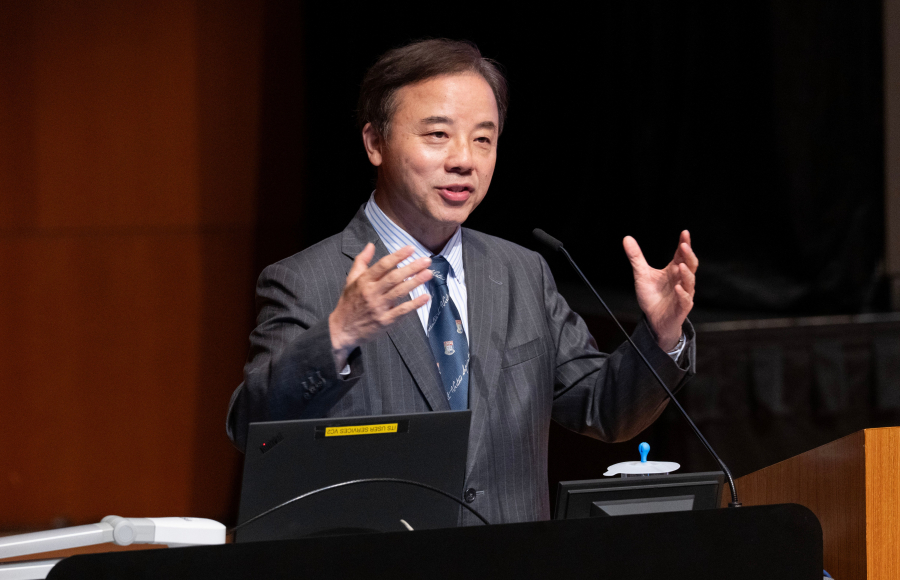
Welcoming the legendary physicist to the stage, Professor Xiang Zhang, President and Vice-Chancellor of HKU, said, “Professor Geim’s experience demonstrates to us the power of basic research. Without basic research, there will not be knowledge translation, not to mention entrepreneurships and disruptive technologies that the world now emphasises. As educators, we really hope that having Prof Geim with us will inspire our next generations to think how to re-define our future.”
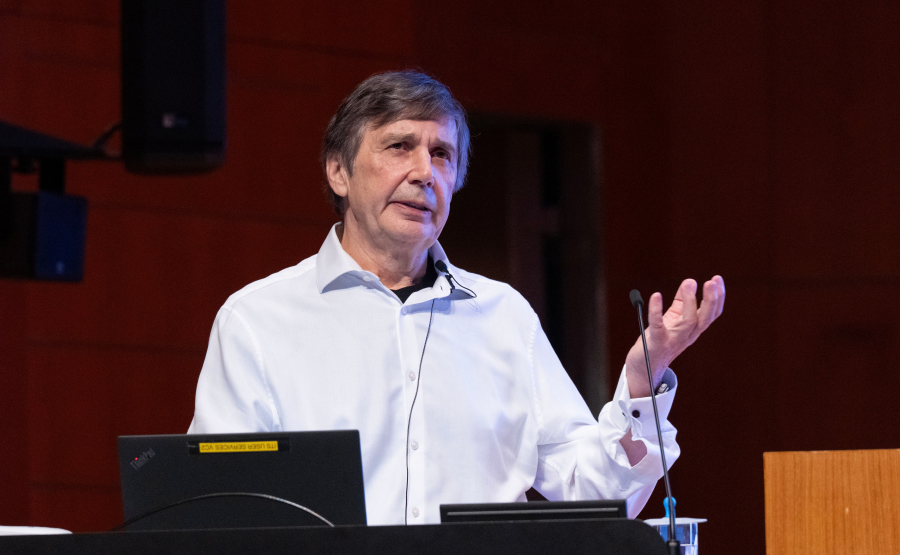
Taking the podium, Professor Geim offered a refreshingly candid look behind the scenes of high-level scientific discovery. “When someone wins a Nobel Prize, people naturally want to know how and why it happened”, Professor Geim shared. “In this talk, I wanted to recount my rather unpredictable path in academia – a story marked by curiosity, wrong turns, and a few strokes of good fortune.”
Graphene was once dismissed by theorists as an impossible dream – an unstable “wonder material” that could not exist independently in our three-dimensional world. However, in 2004, Professor Geim and his collaborators turned theory into reality by successfully isolating the world’s first stable, single-atom-thin sheets of carbon using “sticky tape”. This paradigm-shifting achievement earned them the 2010 Nobel Prize in Physics.
Beyond this landmark breakthrough, Professor Geim’s team pioneered the wider field of two-dimensional (2D) crystals. By demonstrating that atomically thin layers of various materials could be isolated and then stacked back together like atomic Lego bricks, they unlocked an entirely new realm of materials science. Rather than resting on his laurels, Professor Geim’s current work focuses on expanding this atomic toolkit. By exploring a growing family of 2D materials and assembling them layer by layer, his team is creating “designer” materials with properties that do not exist in nature. At HKU, Professor Geim intends to continue this role as an "atomic architect." He believes humans are on the cusp of a fundamental technological shift comparable to humanity’s transition from the Stone Age to the Bronze Age.
Professor Geim’s appointment at HKU underscores the University’s commitment to bridging fundamental, curiosity-led science with real-world applications. By bringing world-leading minds to campus, HKU continues to champion its vision of becoming a world-leading university transforming humanity’s future.
 Facebook
  HKU IOS App
  HKU Android App
  Social Media and Apps